

World Malaria Day | Rapid Detection of Malaria Parasites with GenDx Biotech ERA Technology
updated time:2026-04-23
updated time:2026-04-23
April 25 is World Malaria Day.
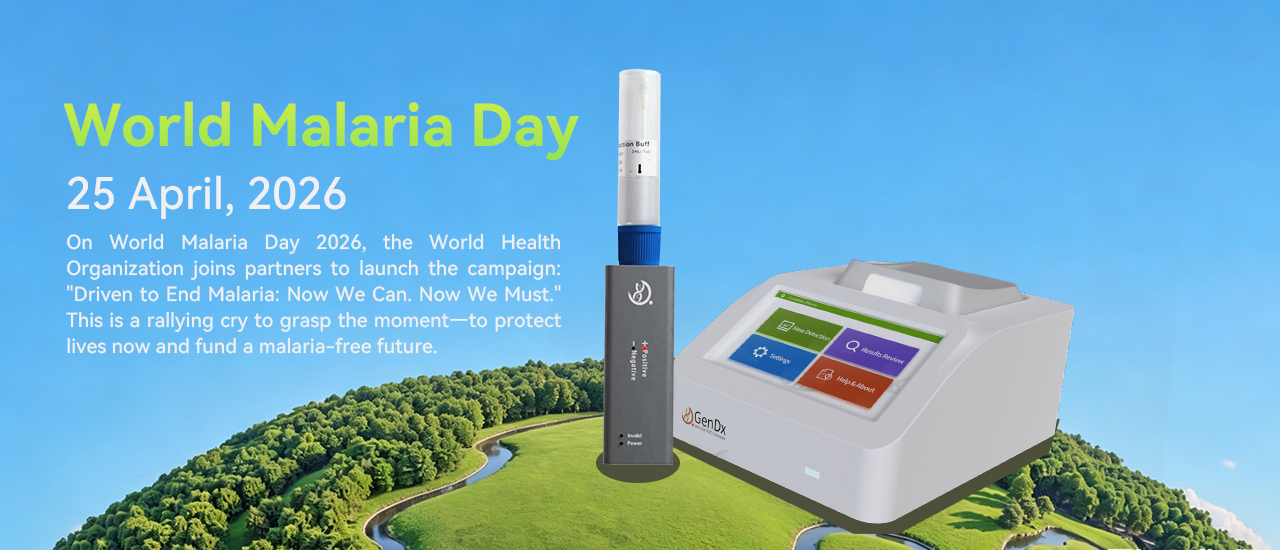
Although humans have battled malaria for millennia, this disease transmitted by tiny Anopheles mosquitoes remains one of the world’s most serious public health challenges. In this long‑term fight, rapid, accurate, and user‑friendly diagnostic tools are critical to identifying infection sources and blocking transmission.
Traditional microscopy and rapid diagnostic tests (RDTs) are widely used at the primary care level but have limitations, including limited sensitivity, reliance on expertise, and difficulty distinguishing mixed infections. Conventional nucleic acid detection methods (such as qPCR) require specialized laboratories and trained personnel, making them hard to deploy in resource‑limited malaria‑endemic regions.
GenDx Biotech’ proprietary ERA technology, paired with the GENEYE® detection platform. The system is compact and portable, with extremely high amplification efficiency that completes testing in tens of minutes — making it an excellent solution for precise malaria prevention and control.
1. The Powerful Advantages of ERA
Experts from the Fifth Medical Center of the Chinese People’s Liberation Army General Hospital developed and validated an ERA‑based method for rapid malaria parasite detection [1].
Comparisons between clinical samples and fluorescence quantitative PCR yielded the following results:
Multiplex assay time: 25 minutes (only one‑step lysis, no nucleic acid extraction required)
Limit of detection: 250 copies/mL
Clinical sample positive detection rate: 94.54% (52/55 positive), 0 false positives (0/20 negative)
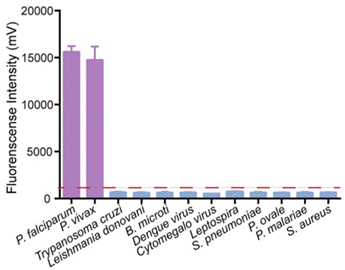
Detection specificity: No cross‑reactivity with Babesia microti, Trypanosoma cruzi, Leishmania donovani, Dengue virus, Cytomegalovirus, Leptospira, Streptococcus pneumoniae, Staphylococcus aureus, Plasmodium ovale, or Plasmodium malariae — only targeting Plasmodium falciparum and Plasmodium vivax.
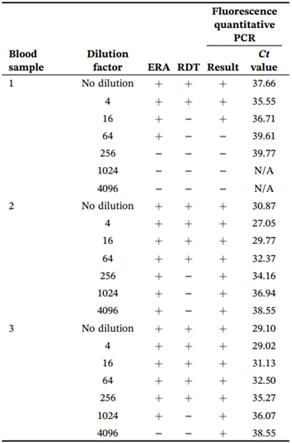
Dilution assays showed that the ERA method and fluorescence quantitative PCR had comparable detection performance, both detecting blood samples diluted up to 1024‑fold and even 4096‑fold. In contrast, the colloidal gold immunochromatographic assay had significantly lower detection capacity than ERA and qPCR.
These findings demonstrate that ERA detection offers strong specificity, repeatability, and stability. As a promising alternative method, it can be used for rapid on‑site detection of P. falciparum and P. vivax infections and surveillance of imported malaria cases.
2. A Rigorous Field Test in the Brazilian Amazon
A Brazilian research team conducted a large‑scale field validation of the ERA method with 323 volunteers across three high‑malaria‑burden sites (Cruzeiro do Sul, Mâncio Lima, Guajará). Compared with nested PCR, qPCR, microscopy, and RDTs, the ERA method delivered superior performance [2].
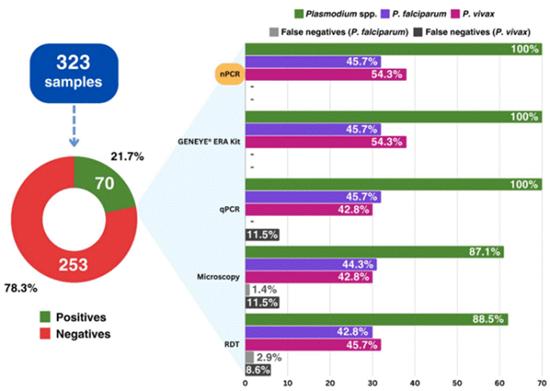
ERA and nested PCR together detected 9 asymptomatic, subclinical infections (1 P. falciparum, 8 P. vivax) that were negative by microscopy and RDT. These silent carriers act as hidden engines of malaria transmission and are completely missed by conventional methods.
To improve usability in remote areas, core reagents for the ERA method in this study were lyophilized. After reconstitution, they remained stable at 4 °C for up to 18 months, greatly reducing dependence on cold‑chain transport and low‑temperature storage.
3. Summary
These two independent studies confirm that ERA technology combines the high accuracy of molecular diagnostics with the convenience of point‑of‑care testing. It is poised to become a valuable tool for primary healthcare facilities in malaria‑endemic areas and can support port‑of‑entry screening, epidemiological investigations, and post‑elimination surveillance — building a strong defense against imported malaria.

On the occasion of 2026 World Malaria Day, GenDx Biotech joins the World Health Organization’s campaign: “Driven to End Malaria: Now We Can. Now We Must.” Together, we take solid steps toward the ultimate goal of a malaria‑free future.
References
[1]Yang X, Lu X, Yang J, et al. Development of an Enzymatic Recombinase Amplification Assay for the Rapid Detection of Plasmodium Nucleic Acids[J]. iLABMED, 2025, 3(2): 182-190.
[2]de Queiroz L T, Baptista B O, de Abreu-Fernandes R, et al. Novel isothermal nucleic acid amplification method for detecting malaria parasites[J]. Applied Microbiology and Biotechnology, 2024, 108(1): 544.