

ERA Reagent Enables Efficient One‑Pot WS‑CRISPR HPV Diagnosis
updated time:2026-05-15
updated time:2026-05-15
Article Title: Gravity‑Driven Formation of Water‑in‑Wax Spheres for Efficient One‑Pot CRISPR Diagnostics
Institution: Tongji Hospital, Huazhong University of Science and Technology
Journal: ACS Nano
Impact Factor: 16.1
The research team developed a gravity‑driven water‑in‑wax sphere (WS‑CRISPR) platform. ERA (i.e., RPA) lyophilized reagents from GenDx Biotech and CRISPR reagents are separately encapsulated inside and outside wax spheres. Through temperature regulation (40°C for amplification, 45°C for wax melting and reagent release), amplification and CRISPR detection are automatically completed in a single tube. The platform enables multiplex detection of all 14 high‑risk HPV subtypes within 30 minutes, with a detection limit of 1×10⁻¹⁸ M. Clinical sample validation shows 97.4% sensitivity and 100% specificity. It is compatible with standard PCR tubes, portable devices and microfluidic chips, making it suitable for large‑scale rapid pathogen screening at the grassroots level.
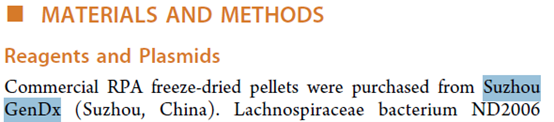
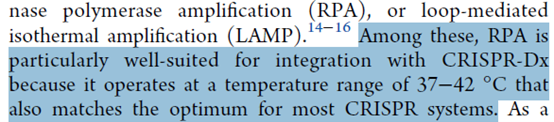
Infectious disease prevention and control urgently require rapid, convenient point‑of‑care testing (POCT) technologies. Traditional PCR relies on sophisticated instruments and laboratory conditions, limiting its popularization at the grassroots level. The ERA ultra‑amplification technology offers advantages of speed, isothermal operation and ease of use. The original paper specifically notes that GenDx’s ERA lyophilized reagents operate at 37–42°C, a temperature range matching the optimal conditions of most CRISPR systems, making them an ideal pairing choice.
This study developed the WS‑CRISPR technology, encapsulating GenDx’s ERA (RPA) reagents and CRISPR reagents into independent microspheres. Temperature regulation enables integrated amplification and detection in a single tube, eliminating the need for tube opening or manual handling. This provides an efficient, reliable new solution for large‑scale rapid pathogen screening at the grassroots level.
1. ERA‑CRISPR Coupling Principle
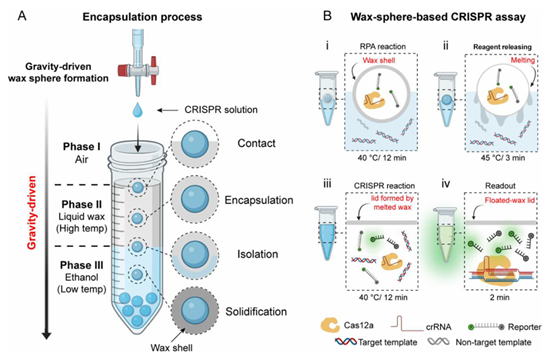
WS‑CRISPR uses gravity‑driven wax sphere encapsulation to separate ERA (GenDx RPA) and CRISPR:
Wax shell: Solid at room temperature, stable at 40°C, melts at 45°C
Outside the sphere: GenDx’s ERA amplification reagents
Inside the sphere: CRISPR/Cas12a detection solution
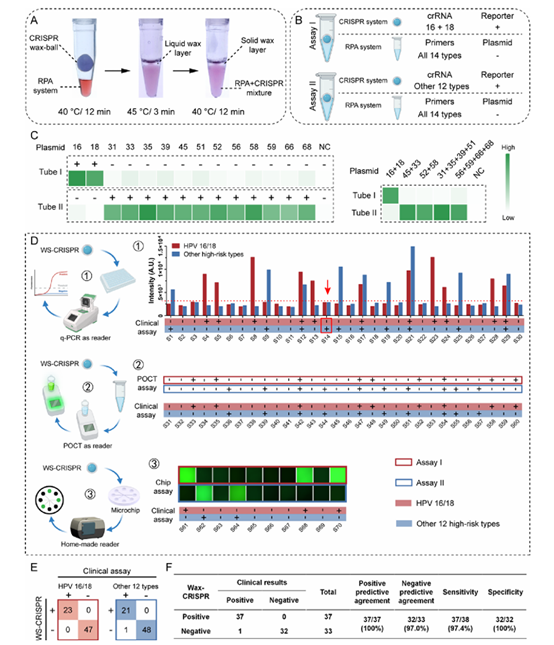
One‑Pot Assay Workflow
40°C (12 min): Wax remains solid → ERA (RPA) amplifies first, CRISPR is isolated to prevent premature reaction
45°C (3 min): Wax melts → CRISPR is released and mixes with amplification products
40°C (12 min): CRISPR cleaves fluorescent reporter molecules to generate results
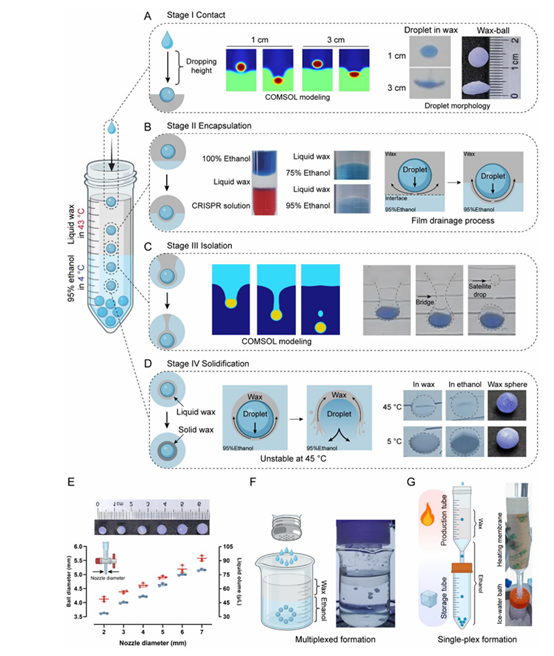
2. Core of WS‑CRISPR: Gravity‑Driven Self‑Encapsulation Mechanism
Combines gravity, density difference and wax phase‑change properties, enabling CRISPR droplets to automatically coat wax and form microspheres without machinery or manual intervention.
Three‑layer liquid stratification: Molten wax (43°C) → low‑temperature ethanol (4°C)
Gravity‑induced descent: CRISPR droplets are denser than wax, falling automatically and coating with liquid wax while passing through the wax layer
Solidification upon cooling: Wax‑coated droplets enter low‑temperature ethanol, where wax solidifies instantly to form solid wax‑in‑water CRISPR microspheres
Controllable size: Nozzles of different diameters produce standardized microspheres of varying sizes for mass production
Reaction Condition Optimization
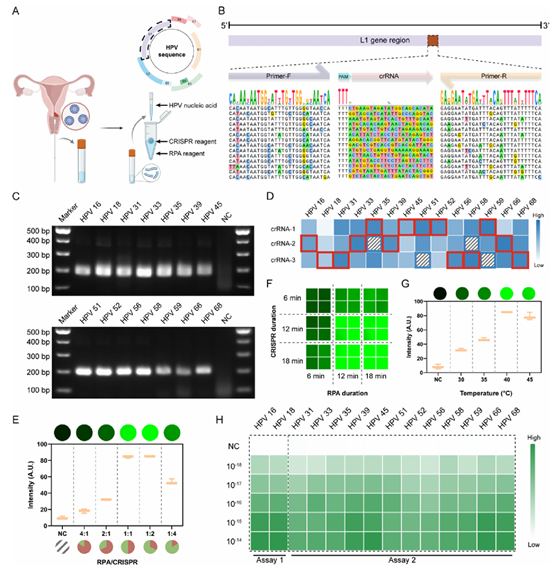
Reagent ratio: Optimal detection performance at ERA:CRISPR volume ratios of 1:1 or 1:2
Reaction time: 12 minutes for both ERA and CRISPR, balancing efficiency and speed
Reaction temperature: 40°C throughout the assay; wax melts at 45°C (3 min) without affecting CRISPR activity
Detection limit: 10⁻¹⁸ M (single copy per reaction) for all 14 subtypes, demonstrating ultra‑high sensitivity
Clinical Grouping Optimization
14 subtypes are divided into a high‑risk group (HPV16/18) and a common high‑risk group (remaining 12 subtypes) for risk stratification and targeted clinical intervention.
3. Detection Performance
Clinical Validation: 97.4% Sensitivity Confirmed in 70 Samples
Ultra‑high sensitivity: Detection limit of \(10^{-18}\,M\) (single copy); complete detection of 14 high‑risk HPV subtypes within 30 minutes
High specificity: 100% no cross‑reactivity or false positives; accurately distinguishes high‑risk HPV16/18 from other subtypes
Excellent clinical performance: 97.4% sensitivity and 100% specificity in 70 clinical samples with stable, reliable results
Wide compatibility: Adaptable to standard PCR tubes, portable POCT devices and microfluidic chips; easy to promote at the grassroots level
4. Advantages of ERA Reagent
GenDx’s nucleic acid amplification kit offers significant benefits: eliminates PCR thermal cycling and adapts to simple temperature control devices at the grassroots level; operates isothermally with reliable performance, completing amplification in 10–15 minutes; can be pre‑encapsulated into microspheres for immediate use, mass production and excellent reproducibility.