

GenDx Biotech's ERA technology has been officially granted a U.S. patent.
updated time:2026-06-18
updated time:2026-06-18
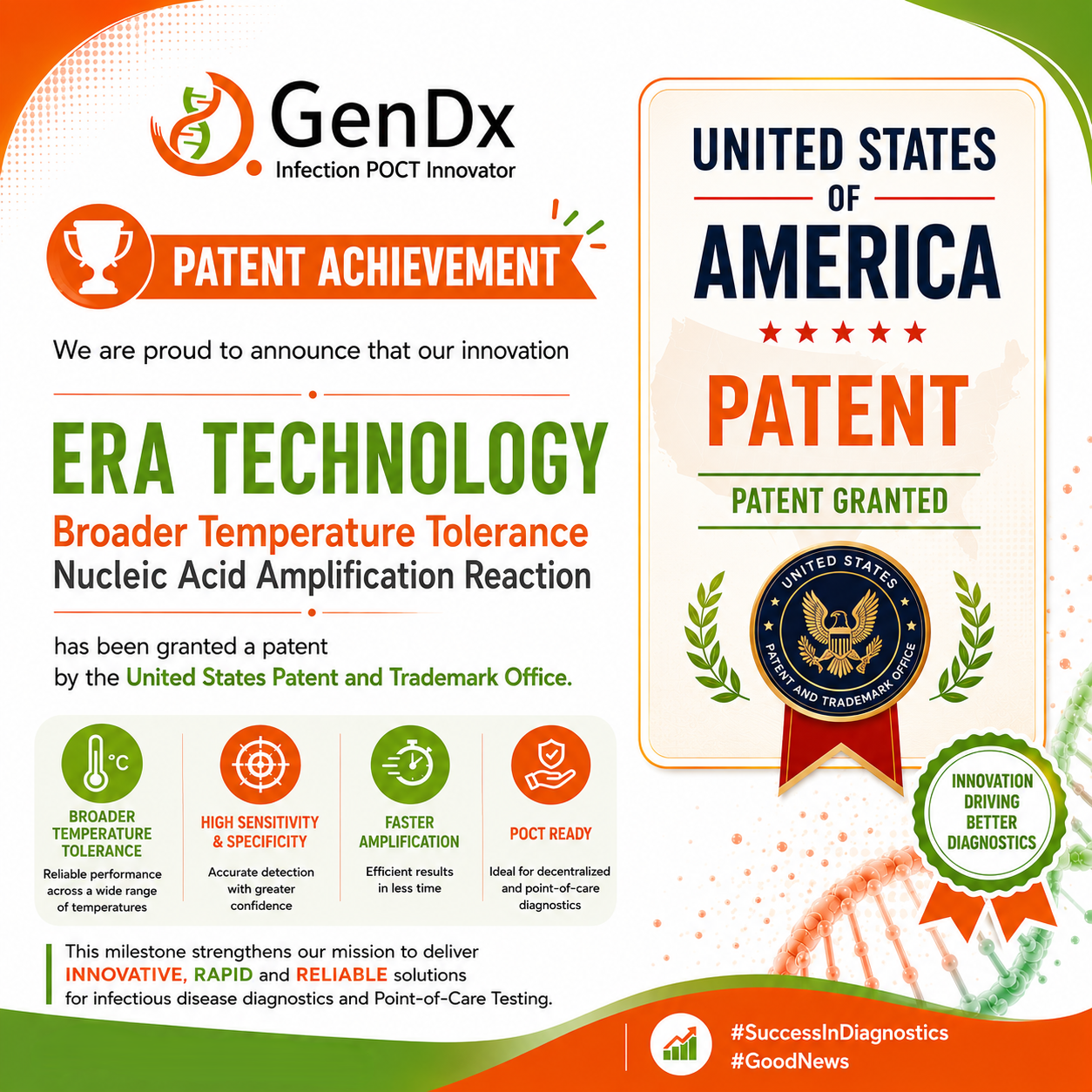
GenDx Biotech's ERA technology has been officially granted a U.S. patent. Relying on this patented technology, ERA will continue to empower on-site rapid nucleic acid testing, providing solid support for the global nucleic acid point-of-care testing business.
Major Announcement
Enzymatic Rapid Amplification (ERA) developed by GenDx Biotech has been granted a U.S.issued patent. Supported by this proprietary right, ERA will empower on site rapid nucleic acid testing and safeguard the development of point of care molecular diagnosis services worldwide.
Enzymatic Rapid Amplification (ERA) is a proprietary isothermal nucleic acid amplification platform independently developed by GenDx Biotech. Adopting molecular design, direct evolution and affinity maturation, GenDx researchers optimized endonucleases, single stranded DNA binding proteins and strand displacement polymerases originating from phages and bacteria.
Distinct from conventional RPA, ERA applies to a reengineered enzyme cocktail. Enzyme numbers, sources, types are fully redesigned, which achieves more efficient, more stable and more accurate.
Key Technical Strengths
Amplification performance: Modified enzymes possess higher catalytic activity, enabling faster amplification compared with standard RPA.
Broad temperature adaptability: The working temperature ranges from 25 °C to 50 °C, supporting stable reactions without precise temperature control at 37 39 °C.
Excellent anti inhibition capability: The system tolerates salts and sample contaminants, allowing direct amplification using simply processed crude samples.
Easy to operate workflow: The isothermal reaction runs without heating cycling equipment, suitable for rapid on site detection.
Application Scenarios
ERA is applied in point of care infectious pathogen diagnosis, public health emergency, livestock and aquatic animal disease testing, food safety analysis, for research laboratories, as well as molecular diagnosis combined with CRISPR technologies.